Pages

Thursday, September 27, 2018

FTIR focus

     I finished my research proposal (and on time too). We treated plastic 4 with alcohol again and tested for contamination on PIA and TSA. So far, no contamination after 48 hours. I think we're good to go. Today we'll redo the SEM pictures of alcohol treated plastic 4, and we'll take new SEM pictures of all Pseudomonas species for all 7 day intervals of plastic 3! This is potentially really momentous because this will be the first time that we'll be looking not just for proof of colonization but also for actual biodegradation particularly between the day 28 co incubation and the alcohol treated control. I think that number 3 will be a particularly good sample to begin to see degradation because in the last SEM pictures we took it were more porous. That makes it more susceptible to degradation because of increased surface area.
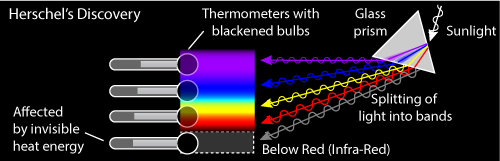
     In addition to that, we've really been cramming this week in preparation for doing FTIR. That is Fourier-transform infrared spectroscopy. As I'm still figuring out the ins and outs, I won't attempt to explain it, but it's based on the infrared spectrum which is very interesting all in its own. It was discovered by William Herschel in an experiment where he was trying to observe temperature differences in the visible light spectrum. He passed light through a prism to separate it and placed a thermometer in each different color. As a control, he put a thermometer next to red. His control was NOT room temperature.

https://www.skepticalscience.com/print.php?n=2275
Anyway, I just thought that was neat, and I was talking to Maria about it, and she's learning a lot about it for her astronomy class. FTIR works my observing absorption and output of infrared light that is unique to a substances functional groups and can be used to identify substances or even molecular changes in substances. That's what we are most interested in. Any molecular changes that might indicate biodegradation of our microplastics.

Tuesday, September 18, 2018

Scanning Electron Microscope and ....you guessed it... RESEARCH!

     I think that I'm not using my time efficiently enough. It's something that I'm always working on including organization. As a result, I worry that I'm not making enough headway in meaningful background research for my project. It just seems that sometimes the things that I'm interested in lead me off in a research rabbit hole until I'm not even super sure where I am. Well, hello Alice. That would be fine, but I need time to do things other than research and half the time I don't even feel like I have the knowledge or experience to understand what I'm reading anyway. It Really gives you an appreciation for all the professors who give it to you like you are a 5 year old. I need some easy, digestible information. LOL. Josh said one time that NOVA was like candy because they spell everything all out for you without you having to do the work to find the information yourself. I need some research NOVA candy. That would be amazing. Then I could just focus on my research instead of decoding other peoples' research. *sigh* Sugar is bad for you. Thinking is good. My physics instructor assures me that my brain will hurt less once it adapts to thinking in new and different ways. I haven't seen any research in evidence of that though, so I guess I better get on it.
     In that same line of thinking, when we were using the SEM we almost had an extremely disappointing moment. The first sample we put into the microscope was plastic 3. Every single part of the picture was blurry. It was terrible, and we just kept trying to look at different areas with different magnifications and different brightness and different contrast and different focus. We burned up too much time before we moved onto plastic 4. Luckily the pictures of 4 were just fine. That's the plastic for which we were worried about contamination. We didn't see any in the pictures (more on that in a moment). Kassandra and Maria couldn't stay a lot longer, so at some point I ended up taking some of them by myself. Dr Hamdan coated 3 in a second layer of gold, and the pictures came out just fine. Dr Hamdan had said that the microscope would only take pictures of "reflective" surfaces, and I didn't even think about it at the time, but that didn't mean reflective like you can see your reflection, I think they meant reflective like one of the physical properties of metals. The SEM only works on conductive materials and that is also a property of metals. In honor of giving it to you like a five year old, I have found the following link:
https://kids.kiddle.co/Scanning_electron_microscope
Which is really a very good place to start to understand if you ask me. I'm feeling very much like a 5 year old trying to understand the mechanics of how the SEM works. The link has a ton of great examples of SEM pictures. Like this:
But I keep wondering how -if we couldn't even take pictures of a porous plastic- did they take pictures of biological samples?! I want to take my very own picture of Pseudomonas fluorescence. I keep hearing, "Don't contaminate the hella expensive piece of equipment", but it's been done, and I wanna do it. Dr Ong said something that made me think that the microscope would burn up anything not coated in gold, and they told me no liquid. Is it that the lack of conductivity burns it up because the electrons that don't bounce off don't have anywhere to go or is it that the moisture in any sample that has it gets too energy excited? Maybe it's both, but if that's the case, HOW DO THEY HAVE FREAKING PICTURES OF BLOOD CELLS??!!
     Plastic 4 IS contaminated. *very unhappy face* We are alcohol treating the already ground up number 4 plastics again.
     What if I heat fixed the bacteria to the double sided tape and mount and then coated it in gold??? I swear I saw a sticky note in that link that had a note saying that it was too "delicate" to be coated in gold, and it looked like those pictures came out just fine. I'm just sayin'. By the way, they also had pictures of SNOW FLAKES.
Wednesday, September 12, 2018

Background Research...Yay...

     So when I started week two, I was very focused on the background research. I really want to understand what other people have to say about Pseudomonas fluorescens and micro plastics, so I'm not beginning completely from scratch.... and now... I think that I realize a bit more how idealistic and vague that statement really is... There is a TON of information and some of it most definitely more helpful. I'm almost relieved that I'm joining an existing research project so I don't have to do it on my own, and on top of that Maria and Kassandra are old pros at some of the stuff that I'm a little wobbly or rusty. I'm grateful for them. I feel like I'm getting to work with them and they're really getting good at some of this stuff. Plus, of course, they've already started the research, so I have specific stuff that they thought was helpful which helps to narrow it down greatly; though, there is still a TON of it. But less of a ton. Lol. 
     Research has kind of taken a backseat as the week has gone on though. We started putting the alcohol treated plastics on TSA and PIA plates to test for contamination. Everything was fine, but plastic 4 has come up with contamination twice! It's a little frustrating, and I'm the one that made those plates, so I keep going back over it in my head wondering if there was some little thing that I did to contaminate it. I'd much rather it be me than the entire plastic sample be contaminated. Maria and Kassandra keep reminding me what a pain it is to create them. Anyway, I can't think of anything that I did and the other five plates that I prepared didn't have any contamination. Boo. Oh! It could be that the plates that show contamination were too wet when prepared. I'm thinking that seems like a Very good possibility because I also prepared a PF plate for my bacteria and when I looked at it under the UV lamp, only the bubbles on the side of the plate fluoresced. Apparently,  Pseudomonas Loves moisture. Obviously, I also had to redo that plate as well. The pictures are pretty cool though. I've got to get back on that background reasearch.

Sunday, September 2, 2018

     This week was all prepping to participate in research. I watched and read lots of lab safety information. Then I identified an unknown bacteria. It was a microbiology throwback. I think that got me into the right headspace to start thinking about my research project. It wasn't difficult. I used the steak plate method to culture onto PSA plates that I incubated at various temperatures. My bacteria had some pretty green splotching (seen in picture). Then I did a gram stain noting the colony and cell morphology. I used a dichotomous key to determine that I needed to do an Oxidase test. Then cultured on some different media. I eventually found out that my bacteria was Pseudomonas aeruginosa. That's one of the bacteria used in the research in which I'll be participating, so that made my heart a little happy. Even at 1000x magnification, I couldn't see any flagella. That would have been extra special cool. I looked it up on Google though. Yay Google, there were lots of good pictures. It still wasn't as cool as seeing it on my own slide.
     I was kind of curious about the practical use of dichotomous keys. Most of what I read afterward seemed to indicate that it's being replaced by the use of identification using genetic markers. Sadly, I was talking to the other members of my research group and they've already done that for the bacteria that we're studying. I missed it! I did get some information that my group has been using for their background research to start my folder on the project. I feel like I'm finally getting started. It's good.